


Stall-Urinals With Basins
Description
This section is from the book "Sanitary Fittings And Plumbing", by G. Lister Sutcliffe. Also available from Amazon: Sanitary fittings and plumbing.
Stall-Urinals With Basins
The stall-urinal constructed of slabs exposes a large surface to the action of urine, and is therefore difficult to keep clean and free from smell. For urinals inside buildings it is a good plan to fix a basin in each stall, as the greater part of the urine is thus confined to a small surface which can be more thoroughly flushed with the same amount of water. Three stalls of this kind are shown in fig. 146. The backs, ends, and divisions may be of slate or marble, and the basins of porcelain, ground to a true surface at the back to fit closely against the slabs. The basin at A has a porcelain down-pipe with flat back ground to a true surface. Down-pipes of this kind often become coated inside with "fur" which gives off an unpleasant odour, and an open arm or socket is therefore sometimes made in it as near the basin as possible so that a brush can be inserted. The same result can be more simply obtained by omitting the porcelain grating in the basin, or by using a loose brass grating. The basin at B has a vertical channel with curved rims, instead of the down-pipe; every part of the urinal, therefore, can be easily cleansed. The basin and vertical channel are made in one piece of porcelain, the design being Shanks's patent. The floor-channel is of white enamelled fireclay, and the fluted floor-slabs of buff glazed fireclay. The flush-pipes are of copper, supplied with water from a single automatic flush tank fixed about 7 ft. from the floor.

Fig. 146. Stall-Urinals with Basins.
Independent Urinals
In some conveniences, where the walls are occupied by water-closets and lavatories, independent or pedestal urinals must be used. These are often hexagonal in plan, as shown in fig. 147. In this, as in many other modern urinals, the backs are made with a forward splay, A, towards the bottom, as this shape reduces splashing and is more thoroughly flushed. A splay of this kind is shown in section in fig. 145 by the dotted line C. The flushing cistern is fixed above the centre of the urinals. The channels are shown at B and the fluted foot-slabs at C. Bolding's "Laydas" urinal is a pedestal trough-urinal, the trough having six lips, with slate or marble divisions between. The cistern is placed over the centre, and actuates a siphon by which the contents of the trough are periodically siphoned out.
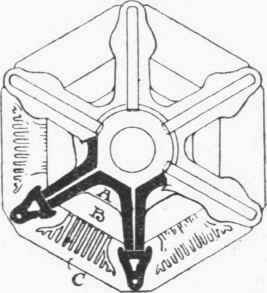
Fig. 147. Plan of Hexagonal Independent Urinal.
Floor-Channels
In all ranges of urinals, except those with front-outlet bases, floor-channels are required. The best material for the purpose is enamelled fireclay, stone and concrete being too absorbent and iron being soon damaged by rust. The channels must be bedded on concrete, and jointed with neat cement. The floor ought to be laid to fall towards the channel about 1/2 in. per foot, so that the water will quickly drain away when the floor is washed with water from a hose-pipe. Glazed floor-slabs ought to be laid between the stalls, and ought to be fluted so that visitors' boots will not be wetted by previous droppings. A dished slab is often laid under a single urinal-basin to receive droppings and drainings from the floor, and in such cases the basin ought to have a down-pipe or channel as shown in fig. 146, delivering over a brass or gun-metal grating in the floor-slab: a trap must of course be fixed under the grating.
Flushing Cisterns
The flushing of urinals is a most important point. Many water companies have no regulations on the subject, but others, including the Metropolitan companies, limit the flush to one gallon. The regulations made under the Metropolis Water Act, 1871, are as follows:-
"Every .... urinal .... in which water supplied by the company is used .... shall be served only through a cistern or service box .... and there shall be no direct communication from the pipes of the company to any .... urinal....."
"Every urinal-cistern in which water supplied by the company is used (other than public urinal-cisterns, or cisterns having attached to them a self-closing apparatus) shall have an efficient 'waste-preventing' apparatus, so constructed as not to be capable of discharging more than one gallon of water at each flush."
Other water companies (Bournemouth, for example) insist on urinals being "supplied with water by meter."
Urinal cisterns are generally of siphonic type, actuated by a drop-by-drop supply. A small tipper is sometimes used for filling the cistern and starting the siphonic action; fig. 148 is a galvanised wrought-iron cistern of this kind, which is made in the following sizes:-1, 1 1/2, 2, 3, 4 and 5 gallons. Urinal cisterns are often constructed with a copper or brass framework and glass sides, so that the attendant can see at a glance whether they are working properly or not. Enamelled fireclay is an excellent material, and marble cisterns with glass panels are also used. Iron is not satisfactory for use in urinals unless vitreous-enamelled.
In the case of single urinals in private houses a one-gallon cistern actuated by a pull-handle is the best arrangement, but for ranges of urinals an automatic cistern regulated to discharge at frequent intervals is more satisfactory. No hard and fast rule can be laid down as to the number of flushes and amount of water required, but it may be stated that in public urinals half a gallon of water per minute per stall is often allowed.
The regulation can be effected by means of a stop-cock on the supply-pipe or by a perforated disc in the union, the latter being required by some water companies. A controlling vessel is sometimes fixed in connection with trough-urinals, by which the number of flushes is 'automatically regulated according to the usage of the urinals. It economises water, but may lead to furring, as a considerable quantity of urine may remain in the troughs for a long period. In other cases a treadle action is adopted, the flush being started by the weight of the person standing on the grating, but the boxes under the gratings are difficult to keep clean, even when they are made of enamelled iron, and part of the flushing water is conveyed into them. Cisterns actuated by the opening of the door of the convenience have also been used, but this arrangement leads to waste of water.
Continue to:


My Books

