


Principal Trap Types
Description
This section is from the book "Sanitary Fittings And Plumbing", by G. Lister Sutcliffe. Also available from Amazon: Sanitary fittings and plumbing.
Principal Trap Types
The D trap has been so frequently condemned by sanitarians that it is now never used by any one with the slightest knowledge of modern plumbing. It cannot possibly be kept clean and becomes in time a miniature cesspool. Its only advantage is that it cannot be unsealed by siphonage; but this is far more than counterbalanced by its uncleanliness. The numerous seams are also sources of danger, and the dip-pipe may be corroded through and allow the passage of foul air, the defect perhaps remaining unnoticed for a long time, as the dip-pipe is concealed within the body of the trap. The "mansion" trap, although an improvement on the D trap, soon becomes foul and is now seldom used.
The "bell" trap (fig. 151) has been very largely used for sinks. It consists of a cup (generally of lead) with a stand-pipe in the middle, over which is placed the brass grate, to the underside of which a "bell" is attached. The bell dips into the water contained in the cup below, and thus forms the seal of the trap. The trap is not self-cleansing, the depth of seal is often less than 1/2 in., and the flow through the trap is so sluggish that servants often remove the bell and grate, thus allowing a free passage for the air from the waste-pipe. In some cases the grate is hinged, but this is no improvement from a sanitary point of view. Antil's lead trap (fig. 152) is better but cannot be recommended. The form illustrated is intended for sinks, and is made in sizes from 2 1/2 to 4 in. at the top, but a modification of it (in lead or brass) is still used for high-class lavatories. Such a trap is shown in fig. 153. A trap of the same general design, but with side outlet, is illustrated in fig. 154.
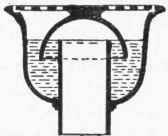
Fig. 151. Bell Trap.

Fig. 152. Antil's Sink Trap.
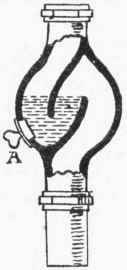
Fig. 153. Oval Lavatory Trap with Bottom Outlet.
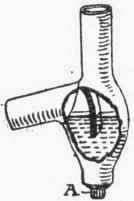
Fig. 154. Oval Lavatory Trap with Side Outlet.
Deposits are certain to occur, and the cleansing screws at A are therefore absolutely necessary; the concealed mid-feather is, however, the most objectionable feature. These traps are often known as "oval" from the shape of the horizontal section of the bodies. Cast-lead traps for sinks are also made of the same design as fig. 153, but with longer necks to pass well through the sink for the purpose of soldering the lead cone to the inlet of the trap. Lead cones (fig. 155) for 1 1/4-in. traps are made to receive 3 or 3 1/2-in. grates, and those for 1 1/3-in. traps to receive 3 1/2 or 4-in. grates. The large grates, of course, ensure a better flow through the traps, but even with this improvement the traps are not self-cleansing, and foul air may pass into the house through perforations or cracks in the concealed mid-feather.
Round-pipe Traps are made in various forms, known by distinctive names. In fig. 156 A is an "S" trap, B a "three-quarter S " or "open S," Ca"P" trap, D a "bag" trap, and E a "Q" trap. Fig. 150 shows a "running" trap. Drawn-lead traps of these shapes are often known as Dubois' traps, and are made in sizes from 1 1/4 in. to 4 1/2 in., each size being made in two weights as follows:-

Fig-155. Lead Cone for Inlet to Trap.
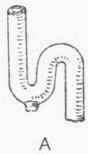
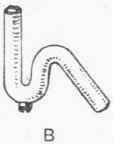
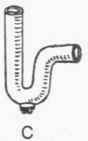
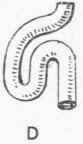

Fig. 156. Round-pipe Traps.
Diameter of Trap. | Weight of Lead per square foot. | |||||||||||
1 1/4 | in. | ... | ... | ... | 4 1/2 | lb. | and | 6 | lb. | |||
1 1/2 | ,, | ... | ... | ... | 5 | ,, | ,, | 7 | ,, | |||
1 3/4 | ,, | ... | ... | ... | 5 1/2 | ,, | ,, | 7 | ,, | |||
2, | 2 1/2 | 3, | 3 1/2 | 4, | and | 4 1/2 | in. | 6 | ,, | ,, | 8 | ,, |
All the sizes from 1 1/4 to 3 in. inclusive, are made either
N
With or without cleansing screws as required. The larger sizes are intended for water-closets and slop-sinks, and are not fitted with cleansing screws. A good form of cleansing screw is shown in fig. 157; when the plug is screwed home the inner surface is flush with the pipe, and affords therefore no obstruction to the flow or lodging-place for deposits. Special drawn lead traps and bends for water-closets and slop-sinks are also made, as shown in fig. 158, the diameters ranging from 3 1/2 to 4 1/2 in.;each size is made in two weights (6 lb. and 8 lb.) and in two lengths (28 in. and 33 in.) to suit different thicknesses of wall. The advantage of these is that they do away with the objectionable joint in the body of the wall.
Cast-lead P and S traps (with or without cleansing screws) are made in two sizes, 1 1/2 in. and 2 in. for sinks and lavatories, and P traps (without cleansing screw) 4 in. in diameter in two weights, for water-closets, etc. Special
4-in. cast-lead P or S traps of 10 lb. lead (fig. 159) are made for water-closets and slop-sinks with bases for fixing to the floor, and with sockets for receiving the basins. Similar cast-lead bases and sockets are also fitted to 3 1/2-in. and 4-in. drawn-lead P and S traps.
In order to insure a more thorough flush of water through the trap, the inlet ought always to be considerably enlarged. In many lavatory basins the waste-plug is only
1 in. or 1 1/4 in. in diameter, and the effective area of the opening is reduced by the solid part of the grating below.

Fig 157. Claughton's Brass Cleansing Screw.
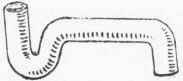
Fig. 158. Drawn-lead P-trap and Bend.
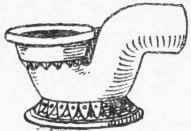
Fig. 159. Cast-lead Water-closet Trap.
To fix a 1 1/2-in. trap under such a fitting is a mistake, as it cannot be properly flushed by the discharge. The area of the openings in the waste-grating ought always to be greater than the sectional area of the trap.
Drawn-lead traps are of equal bore throughout, and some plumbers prefer cast or hand-made seamed traps with square dips and weir outlets, as shown in fig. 160. The depth of the seal is thus considerably increased, and a better scour is obtained in the bottom of the trap. The size illustrated is suitable for water-closets, and has an enlarged inlet, and less easy curves, so as to reduce the risk of siphonage.
Continue to:


My Books

