


Anti-Siphonage Traps
Description
This section is from the book "Sanitary Fittings And Plumbing", by G. Lister Sutcliffe. Also available from Amazon: Sanitary fittings and plumbing.
Anti-Siphonage Traps
Cast-lead traps of various kinds are now made for the express purpose of preventing siphonage in the case of single fittings. Smeaton's "Eclipse" trap (fig. 161) has served as the model from which later designs have been produced. It has a round dip-pipe and the body is designed to give a considerable area of standing water on the outlet side of the trap and a volume of air in the angle above this water. The concealed dip-pipe is objectionable. In Hellyer's "Anti-D" trap (fig. 162) the chief peculiarity is the square outgo. It has the same angular air-space above the standing water as the " Eclipse " trap, but differs from the latter in having two thicknesses of lead between this air-space and the inlet-pipe. The size marked A has a
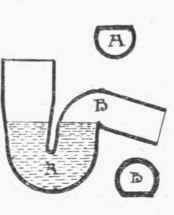
Fig. 160. Hand-made Trap.
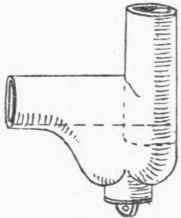
Fig. 161. Smeaton's "Eclipse" Trap.
4 1/4-in. inlet and a 3-in. outlet, and is intended chiefly for valve-closets and slop sinks; B has a 3 1/2-in. inlet and 2 1/8-in. outlet, the depth below the dip being 2 in., and is intended for large sinks and baths; C is a lavatory trap and has a 1 1/4-in. inlet and outlet; D is similar to C, but with the inlet enlarged to 2 1/2 in. and is suitable for lavatories and small sinks and baths. A is of metal equal to 8-lb. lead, and B, C, and D, 9-lb.; the three latter are made with cleansing screws, if required. The depth of seal is in every case about 1 3/4 in., and even the largest trap holds only 2 1/2 pints of water, or less than one-sixth of the quantity generally allowed for flushing a water-closet.
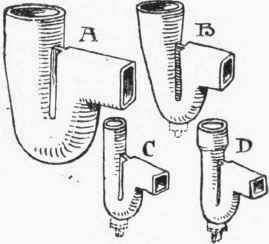
Fig. 162. Hellyer's "Anti-D" Traps.
The "Kensington" cast-lead trap is on somewhat similar lines, having a flat top over the standing water on the outlet side of the trap. It is made in P or S form (fig. 163) in two sizes, 3 1/2 to 1 1/2 in. and 4 in. to 2 in., for sinks, etc, and in P form (4 1/2 in. to 4 in.) for water-closets. These traps are self-cleansing and offer considerable resistance to siphonage.
The "Hadley Anti-siphonic" trap (fig. 164) is guaranteed by the makers "to give a permanent seal under all conditions" without vent-pipe. It is a round-pipe trap with an enlargement on the outlet leg, and with a great depth of seal. Partial siphonage of the trap, may, of course, occur, but it is claimed that the enlarged portion cannot possibly be emptied; the water in this falls back after a discharge and is sufficient to recharge the lower part of the trap. It is made of lead in S and P shapes, and in the following sizes: 1, 1 1/4, 1 1/2, 1 3/4, 2, and 2 1/2 in. for sinks, lavatories, urinals, etc. There is a possibility of deposits accumulating in the enlarged portion.
Mechanical traps are now seldom used as they are not self cleansing. The "Bower" trap (fig. 165) is well known, and, although not the best, will serve as an example. The dip-pipe, outlet-pipe, and upper portion of the body are made in one piece of cast-lead, and the lower portion of the body of lead or glass. A light indiarubber ball (A) in the body of the trap is supposed to seat itself against the dip-pipe and form an efficient barrier against the entrance of foul air into the house. The ball obstructs the passage of the water through the trap, and deposits are certain to occur. A perforation in the upper part of the dip-pipe might pass unnoticed for a long time, as it is concealed in the body of the trap.
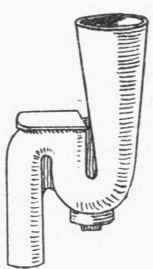
Fig. 163. The "Kensington" Trap.
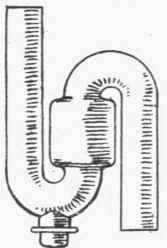
Fig. I64. The " Hadley Anti-syphonic:' Trap.
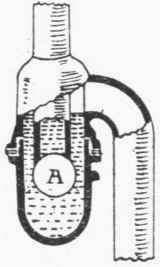
Fig. 165. The "Bower" Mechanical Trap.
Materials
Lead is the metal most generally used for the traps of those sanitary fittings which are not trapped in themselves, but iron, brass, and white metal are also used. Seamed-lead traps made by hand are now seldom adopted; they are costly, and are soon corroded along the seams, besides being subject to defects due to careless workmanship. The seams are generally soldered, and may be either wiped or formed with the tool known as the "copper bit," the wiped seam being the better of the two. "Burned" seams require special apparatus, and are not often made by the journeyman plumber. In these seams the joint is formed with lead instead of solder, thus avoiding the galvanic action set up between the tin and lead. Cast-lead traps with burned seams are generally produced in factories. The example shown in fig. 166 is known as Claughton's and is cast in two pieces, which are afterwards united by burned seams. Webs are cast on at AA to prevent the drooping of the outgo, which is sometimes so serious as to destroy the seal of an ordinary trap. S and P traps of this form are made in three sizes, 1 1/4 in., 1 1/2 in., and 2 in., and running traps in two sizes, 1 1/2 in. and 2 in. The lead is equal to 7 1/2 lb. per sup. ft.
Several examples of cast-lead traps have been given. If properly made they ought to be smooth inside, and the metal ought to be of equal thickness throughout and free from pinholes and other defects. Drawn-lead traps are made by forcing lead through annular dies, as in the process of pipe manufacture, but special arrangements are adopted for bending the pipes to the desired curves. Drawn-lead traps are as smooth inside as outside, and are of uniform bore throughout. When the inlets are of proper size the traps are self-cleansing, but the smooth surfaces and easy curves render them peculiarly liable to unsealing; hence the necessity of trap-ventilating pipes.
Cast-iron traps are made in various sizes for sinks, baths, water-closets, and other fittings, and are suitable for tenement dwellings and other places where rough usage may be anticipated, and where the value of lead and brass might lead to theft. Several examples have been given in preceding chapters. Tye & Andrews' sink traps are of P and S shape, with a mid-feather between the inlet and outlet portions. They are made in three sizes,-3-in. grate, with 1 1/2-in. outlet; 4-in. grate, with 2-in. outlet; and 6 in. grate, with 3-in. outlet. Brass clip grates are provided for stone sinks, and brass screw grates (fig. 167) for lead and slate sinks. The outlet may be screwed, as in the illustration, for connection to an iron waste-pipe, or plain for connection to a lead waste-pipe. For baths and lavatories the inlet and outlet are screwed. The cleansing screw is of brass, and may be placed in the side or bottom of the trap, the latter position being more convenient for removing deposits. The traps are without ventilating arms, and any imperfections in the mid-feather may pass unnoticed for a long time. The traps are galvanised, but the coat of zinc affords very little protection. Other cast-iron traps are coated with Angus Smith's solution, or by the Bower-Barff process, but better protection is afforded by vitreous or porcelain enamel. The castings ought to be smooth, of uniform thickness, and free from pinholes and other defects. A glass-enamelled iron mid-feather trap for lavatories is shown in fig. 55, page 61; cast-iron bath-traps in figs. 79, 80, and 82, and a cast-iron water-closet trap in fig. 98.
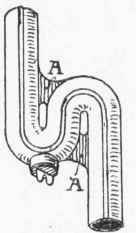
Fig. 166. Claughton's Cast-lead S trap with Webs and Burned Seams.
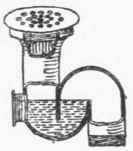
Fig. 167. Tye and Andrews' Cast iron Sink-traps.
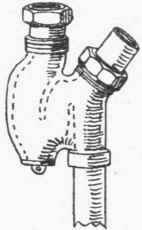
Fig. 168. Cast-brass Mid-feather Trap.
Cast-brass traps are often used for lavatories, and less frequently for baths and sinks. A common form for lavatories is shown in fig. 153. It is neat in appearance, but is not self-cleansing. The brass mid-feather trap with vent-union (fig. 168) is on somewhat similar lines, with 1 1/2 in. inlet and outlet. Two forms of bath-trap were illustrated in figs. 77 and 78, the latter having a coupling for an anti-siphonage pipe. The common defect of brass traps is that they are very rough inside, and deposits are almost certain to occur in consequence. On the other hand, they are stronger, and less easily corroded than lead. Some makers prefer to leave the traps dull outside, while others finish them by polishing or nickel-plating.
White metal traps follow the same lines as brass traps, but are about 25 per cent. more costly.
Glazed-ware traps are made for laboratory and kitchen sinks. They are generally 2 in. in diameter, and of P or S shape. An example was given in fig. 27. They are self-cleansing and incorrodible. Glazed-ware traps for water-closets and slop-sinks have been illustrated in the chapters on those fittings.
Continue to:


My Books

