


Soil-Pipes. Part 2
Description
This section is from the book "Sanitary Fittings And Plumbing", by G. Lister Sutcliffe. Also available from Amazon: Sanitary fittings and plumbing.
Soil-Pipes. Part 2
The following table gives a list of some of the pipes now manufactured, with the weight of the lead per superficial foot in each case:-
Drawn-lead Soil-Pipes
Internal diameter in inches. | Weight in lbs.- A, per 10-ft, length. B, per super. ft. of Metal. | ||||||||||
2 1/2 | A | • • • | 36 | • • • | 45 | • • • | 50 | • • • | • • • | 60 | • • • |
2 1/2 | B | • • • | 5 5/16 | • • • | 6 2/3 | • • • | 7 1/4 | • • • | • • • | 8 5/8 | • • • |
3 | A | • • • | 45 | • • • | 53 | • • • | 60 | • • • | 68 | 74 | 80 |
3 | B | • • • | 5 5/8 | • • • | 6 1/2 | • • • | 7 1/3 | • • • | 8 1/4 | 9 | 9 5/8 |
3 1/2 | A | • • • | 52 | 57 | 60 | 65 | 70 | 76 | 80 | 90 | • • • |
3 1/2 | B | • • • | 5 1/2 | 6 1/24 | 6 3/8 | 6 7/8 | 7 3/8 | 8 | 8 3/8 | 9 3/8 | • • • |
4 | A | 56 | 60 | 65 | 70 | 74 | 80 | 87 | 90 | 100 | 112 |
4 | B | 5 1/4 | 5 5/8 | 6 1/24 | 6 1/2 | 6 7/8 | 7 3/8 | 8 | 8 5/16 | 9 3/16 | 10 1/4 |
4 1/2 | A | • • • | 70 | • • • | 80 | • • • | 90 | • • • | IOO | 112 | • • • |
4 1/2 | B | • • • | 5 4/5 | • • • | 6 5/8 | • • • | 7 7/16 | • • • | 8 1/4 | 9 3/16 | • • • |
5 | A | • • • | 75 | • • • | 88 | 92 | 100 | • • • | 112 | • • • | • • • |
5 | B | • • • | 5 5/8 | • • • | 6 5/8 | 6 7/8 | 7 7/16 | • • • | 8 5/16 | • • • | • • • |
5 1/2 | A | • • • | • • • | 90 | • • • | . . . | 106 | • • • | • • • | • • • | • • • |
5 1/2 | B | • • • | • • • | 6 1/8 | • • • | • • • | 7 1/5 | • • • | • • • | • • • | • • • |
6 | A | • • • | 90 | • • • | 106 | 110 | 120 | • • • | • • • | • • • | • • • |
6 | B | • • • | 5 5/8 | • • • | 6 5/8 | 6 7/8 | 7 1/2 | • • • | • • • | • • • | • • • |
Specially heavy pipes are also made as follows, but are not often used for soil-pipes:-
2 1/2 | inch, | 21, 25, 29, 33 1/2, and 36 lbs. per yard. |
2 3/4 | ,, | 30 and 37 1/2 lbs. per yard. |
3 | ,, | 30. 33 1/2, 36, 39, 42, and 45 lbs. per yard. |
3 1/2 | ,, | 33 1/2, 39, 45, 48, and 54 lbs. per yard. |
4 | ,, | 42, 48, 51, 60, 68, and 90 lbs. per yard. |
4 1/2 | ,, | 42, 51, and 66 lbs. per yard. |
5 | ,, | 45, 66, and 75 lbs. per yard. |
5 1/2 | ,, | 66 lbs. per yard. |
6 | ,, | 66 lbs. per yard. |
The minimum weights demanded by the London County Council per 10-ft. length are 65 lbs. for 3 1/2-in. pipe, 74 lbs. for 4-in., 92 lbs. for 5-in., and 110 lbs. for 6-in. In 1899 an attempt was made to increase the weights to 70 lbs., 80 lbs., 100 lbs., 120 lbs. respectively, but the suggested alterations have not been adopted. The minimum weights required by the existing by-laws give a thickness of metal equal to sheet-lead weighing about 6 7/8 lbs. per square foot, which the suggested alterations would have increased to 7 1/2 lbs. per square foot. The latter weight is sufficient for all ordinary purposes, although some sanitarians think that metal, weighing less than 8 lbs. per square foot, ought never to be used for soil-pipes; where the money can be afforded, pipes with metal weighing 10 lbs. per square foot are often used. As a ready means of calculating the thickness and weight of the metal, it is convenient to remember that a square foot of lead 1 in. thick weighs about 59 lbs.; the weight of metal J in. thick is iherefore very nearly 7 1/2 lbs. per square foot.
The joints in lead soil-pipes and between lead and iron, lead and pottery, etc, have been described and illustrated in Chapter XX (Joints In Pipes). The method of fixing remains to be considered.
Pipes in chases are fixed on blocks by means of lead flanges soldered to the pipes; the joints are often of the flange type (fig. 179, page 200), and an additional flange with blocks should be provided between each pair of joints, so that the pipes will be supported every 5 ft. Internal soil-pipes in London must be constructed of drawn lead "with proper wiped plumber's joints; and so as to be easily accessible" and pipes with flanged joints fixed in chases are therefore not admissible.
Pipes fixed to the face of a wall may be united by wiped joints and supported by lead tacks soldered to the back of the pipes. The lead should be of the same thickness as the substance of the pipe, and should be about 4 in. wide if net to be folded, and double this width if folded to protect the nail-heads; the height should be 5 or 6 in. if two nails are to be driven through each tack into the joints of the brickwork, and 9 or 10 in. if three nails are used. The latter size gives better support. Tacks are sometimes placed singly and alternately on opposite sides of the pipe; at least three ought to be allowed for each 10-ft. length. Greater strength with neater appearance is obtained by fixing them in pairs, allowing two pairs to each length. The nails may be of iron, 3 in., 3 1/2 in., or 4 in. long, or of copper or gunmetal, the two latter metals being more expensive but much more durable; the heads are often rounded. Iron nails should be galvanised, and the heads may with advantage be covered with lead. The nails should of course be driven into the horizontal and not the vertical joints of the wall.
Copper-bit joints are sometimes used, the pipes being fixed with tacks and ornamented at the joints with lead beads, as shown in fig. 174. Cast-lead sockets (fig. 175), or cast-lead sockets strengthened with copper (fig. 176), are also good methods of fixing. Additional support ought to be given by a pair of tacks at the middle of each length.
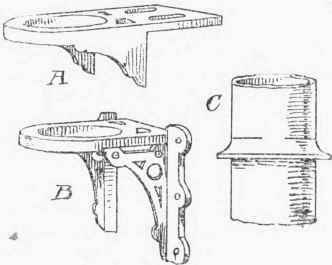
Fig. 200. Cast-iron Brackets for Soil-pipes.
Two objections to lead tacks are that the pipes are supported only at the back, and are consequently apt to be dragged out of shape, and that the pipes are fixed close to the wall rendering it difficult to make and repair the joints. Both these objections can be met by the use of cast-iron brackets as shown in fig. 200; A is intended for building into the wall, B for nailing to it. A strong lead or brass collar must be wiped to the pipe as shown at C to transmit the weight to each bracket. The brackets ought not to be more than 5 ft. apart. The joints in the pipe ought to be plumber's wiped joints.
Cast-lead sockets (fig. 201), 3 1/2 in. and 4 in. in diameter, with arms from 15 in. to 30 in. long are now made, so as to avoid the "branch" wiped joint close to the wall. The arm can be connected to the closet by a brass socketed ferrule (fig. 202), in which a 2-in. branch is formed for the lead anti-siphonage pipe. If the anti-siphonage pipe is of iron, a socket is cast on the end of the curved branch, so that the end of the pipe can be caulked into it. The feet of lead soil-pipes may with advantage be connected to cast-iron bends, which ought to have foot-rests cast on and be supported on flags or concrete; iron bends are better able to resist the impact of the falling liquids and solids, and also allow a good connection to be made with the drain.

Fig. 201. Cast-lead Socket with Branch.
2. Iron. - Wrought-iron is seldom used for soil-pipes, although it is well adapted for the purpose. As a rule, cast-iron pipes are used in 6-ft. lengths with socket joints caulked with lead. Pipes 3 in. and upwards in diameter are also made in 9-ft. lengths, and these have the advantage of fewer joints. Special "making-up" lengths can, of course, be cast to order. The great defect of the material is its liability to corrosion, particularly in that part of the pipe above the highest branch. Unprotected iron pipes ought, therefore, never to be used. A coat of paint applied to the outside is of no use in preventing internal corrosion. Pipes galvanised inside and out can be obtained, but the cost is about double that of plain pipes and the protection is only temporary. Dr. Angus Smith's solution, applied at the foundry, is the cheapest preservative, and is fairly durable but not by any means permanent. The Bower-Barff process is not so often used for soil-pipes, and is not always successful. Glass-enamelling affords, perhaps, the best protection, but care must be observed that the enamel is perfect throughout the pipe and that it is not damaged by cutting or jointing the pipes.
Continue to:


My Books

