


Waste Plugs
Description
This section is from the book "Sanitary Fittings And Plumbing", by G. Lister Sutcliffe. Also available from Amazon: Sanitary fittings and plumbing.
Waste Plugs
In the case of baths, which, being fixed at a low level, are liable to severe blows from falling plugs, it is highly desirable that chained plugs should be as light and soft as possible; this is especially necessary for japanned and metallic-enamelled baths, as a single blow from a hard and heavy plug may destroy the enamel at the point of impact and expose the metal beneath. For this reason india-rubber and vulcanite plugs are to be preferred; the extra cost is very small. Indiarubber plugs with metal cores are also made, but are as a rule too heavy.
The plugs for baths are made in various sizes -1 1/4 in., 1 1/2 in., 2 in., 2 1/2 in., 3 in., and even 4 in. The waste shown in fig. 76 has the following dimensions for a 2 1/2-in. plug-diameter of flange, 4 in., and diameter of screw, 2§ in. It is made in brass (either plain or nickel-plated) or in white metal. The waste with tapered tail, shown in fig. 32, page 48, is well adapted for baths; the plug is 3 in. in diameter (either brass or vulcanite), and the tail is tapered from 3 in. to 2 1/4 in. This waste ensures a rapid discharge from the bath and a thorough scouring of the trap and waste-pipe. Bath plugs ought not to be less than 2 in. in diameter, or the waste-pipes less than 1 1/2 in.
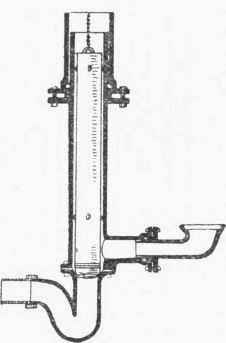
Fig. 81. Standing Waste and Overflow.
Standing Wastes and Overflows are largely used for baths. Fig. 81 shows the ordinary type. The standing overflow, of copper or brass, is placed in a tube outside the foot of the bath, and has generally a rubber covering at the end to make a tight joint on the valve seating. It is raised by means of a chain (or spindle) and knob. Whenever the bath is used, water rises in the annular space between the two tubes, and if the taps are not turned off will eventually flow over the rim of the inner tube, and pass down this tube and through the trap. As there is no scour through the annular space, it is apt to become somewhat foul. This defect is obviated in Doulton's improved arrangement (fig. 82), in which a standing overflow is placed in a recess at the foot of the bath; the overflow can be removed by lifting it upwards after raising the waste-pull. A porcelain soap-dish is fitted across the foot of the bath.
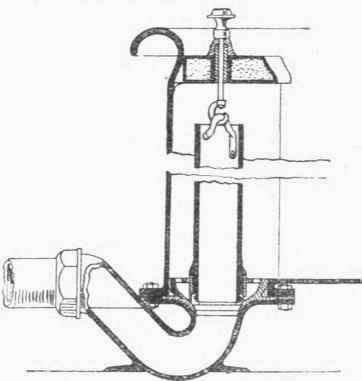
Fig. 82. Doulton's Exposed Standing Waste and Overflow.
The trap is of glass-enamelled cast-iron, 2 in. in diameter, and the outlet grating is of large size flush with the bottom of the bath.
The siphonic standing overflow (fig. 47, page 57) and the "Loco" (fig. 48, page 57), are now fiited to baths, as well as to lavatories and sinks.
As a rule the fittings are arranged at the foot of the bath, but cast-iron and other baths are now made with the fittings arranged at the front, a position which is often advantageous when the bathroom is small.
The Combined Bath and Lavatory shown in fig. 83 is also used in similar situations. The bath is of cast iron, painted, japanned, or enamelled in various ways, and the lavatory basin is of enamelled iron, made to tip up and discharge the contents into the bath. The hot and cold water is supplied through a swivel arm A, which can be turned to fill either the basin or the bath. A soap-dish is cast at one corner on the roll edge.
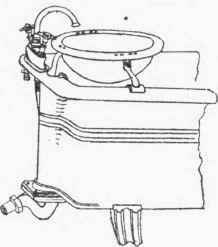
Fig. S3. Combined Bath and Lavatory.
Continue to:


My Books

